they tell us it’s low risk

The neurosurgeon talked me through the procedure last week.  I’ll share it here, for those who are interested.  According to the neurosurgeon (and lots of other specialists we have seen), this surgery is the lowest risk (easiest) surgery that a neurosurgeon can perform.  In fact, the risk of not going through with the surgery is greater than the risk of having the surgery.  If we didn’t go through with surgery, the nerve damage could be permanent.  The risks associated with the surgery include a CSF (cerebrospinal fluid) leak and infection.

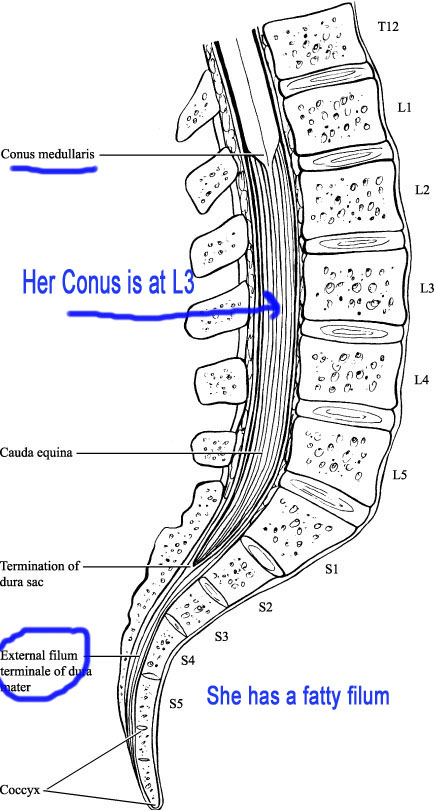
The surgery involves a small incision at the L4/L5 postion.  A very small amount of bone will need to be removed between the vertebrae, but should not effect the stability of the girl’s spine.  The neurosurgeon will not need to perform a total laminectomy, but will work between the vertebrae to expose the dura (outer layer).  The filum will be located (dissected) from among a lot of nerve roots (the spinal cord is not this low).  According to the surgeon, it’s kind of like looking at a broom with all yellow bristles and one black one.  The filum would be the black bristle.  It looks different.  It also is not a nerve, so will not respond to stimulation.  Before anything is cut, the surgeon will stimulate everything (including the filum) and record the response (to the legs and other lower anatomy).  The filum should not have a measured response…and so it will be cut.  He will cut half-way, then re-stimulate before he finishes with the cut.  After the filum is released, he will stitch everything back together.

image credit: http://www.imaios.com/en/e-Anatomy/Spine/Spinal-cord-diagrams

The girl will spend 3 days in the hospital with her head at the same level as the incision.  This is to keep the CSF pressures equal along the spinal canal, and it should help prevent a CSF leak.  Then we get to go home and we will spend 2 weeks as still as a 3 year old can be.

I found this video that might be of interest (not the girl’s doctor):
A date is set

May 17!

That’s the day.  Of course, I would like for it to be tomorrow so that we can be done, but this is the earliest we could schedule.  The doctor called me yesterday (to save me a trip to clinic…how nice?).  He explained in great detail (indulging the science-mommy) how he would release the filum.  He assured me that the girl would be able to wear a bikini one day because he had studied with a plastic surgeon.  I didn’t tell him that I thought that the girl’s daddy would have more of a say in that decision than a little scar!  Bikinis aside, the horizontal type of incision that the surgeon will use heals better than the vertical incision.  That’s always good!  After our discussion, I feel even more confident in this surgeon and that God led us to him.

The surgery will be at Children’s (too bad the new hospital isn’t open yet), and the girl will be in the hospital for 3-4 days.  When we get home, we will spend 2 weeks as a couch potato.  She can get up 5 times a day for 30 minutes.  The girl has such a high pain tolerance, that I imagine keeping her still will be the hardest part.  I guess we will read every book in the library, and watch a lot of PBS! After all of the rest, we can work on getting strong again at PT!

Now we wait.  We are going to try to do as many fun things as we can over the next two weeks.  We will visit our Nana and our friends in Indiana and run around, ride a tractor, and pet the sheep.  The girl’s Nonnie is coming, and we will find all kinds of trouble with her.  We will have as many play dates with our friends as possible, and for sure we will plant flowers with Aunt J.  We will also practice the cello and keep working on our goal of learning “Monkey Song”.

I will post more later about the procedure – for those who would like to know the details.


What is a tethered cord?

When the spinal cord is not free to move in the spinal canal, tension on the cord can damage nerves that may result in loss of bladder control, problems with walking, sensory changes, and orthopedic problems including foot deformities and scoliosis (Hertzler et al.  2010, Liu et al. 2011).  There are multiple causes of tethered cord syndrome (TCS), and the symptoms are varied and involve multiple systems (Hertzler et al. 2010, Liu et al. 2011).  Sometimes TCS is recognized by the presence of external signs including lesions, hairy patches, deep dimples or fatty tumors; however, it’s not always identified until a child is older and starts to exhibit problems with bladder control, walking or other neurosensory issues during growth spurts (Hertzler et al. 2010, NINDS).

TCS is diagnosed via MRI and evaluation of symptoms.  The position of the conus medullaris below the L1 vertebrae, presence of a fatty tumor (fibrolipoma), and thickness of the filum terminale are associated with a tethered cord.  It is not always possible to see the actual tethering via the MRI (my understanding).  In addition to an MRI, urodynamic studies can be helpful in making a diagnosis.  A Cystometry (CMG) study evaluates the capacity of the bladder and how well the sensory input is working.  The nerves at the base of the spinal cord innervate the bladder, so when there is a lot of tension in the cord, problems with continence can develop.  TCS can be treated via surgery (de-tethering), and the prognosis is good!

http://www.emedicinehealth.com/cauda_equina_syndrome/page15_em.htm

Sources:

Hertzler et al. 2010.  Tethered cord syndrome: a review of the literature from embryology to adult presentation.  Neurosurg Focus 29(1):E1.

Life Tech International.  2011.  Clinical application notes: Introduction to Urodynamics III: Urodynamic procedures, CMG.  http://www.life-tech.com/uro/urolib/cystometry.shtml  accessed 24 April 2012.

Liu et al. 2011.  SEM tudy on filum terminale with tethered cord syndrome.  Childs Nerv Syst 27:2141-2144.

NINDS. 2011.  NINDS tethered spinal cord syndromw information page.  http://www.ninds.nih.gov/disorders/tethered_cord/tethered_cord.htm  accessed 24 April 2012.

The Girl’s Journey

When the girl was 2 months old, I took a photo of her bum.  It was just so cute I couldn’t resist.  When I looked at the photo on the computer screen, I noticed that it wasn’t quite right.  What should be straight, was a bit crooked!  This was what started our journey.  We saw a neurosurgeon who ordered an ultrasound.  At this point, her bones were starting to ossify.  The doctor didn’t see anything of concern, we breathed a sigh of relief and drove home!

She always had problems with her gut.  Once we figured out the food allergies, she switched from too fast to too slow.  In fact slow is probably a generous term.  For two years she struggled, and we used every kind of laxative known to man.  That little crooked bum kept us thinking that there might be a problem that we should rule out.  In the spring of 2011, the gastroenterologist agreed that the girl should have an MRI so that we could rule out a problem with her spinal cord.  The results were:

“Borderline low-lying conus terminating at the superior L3 vertebral body level…focal fat attenuation and borderline thickening of the filum terminale, indicative of fatty infiltration/fall small fibrolipoma… findings are nonspecific, but do have an association with cord tethering.”

We returned to the neurosurgeon, and while he agreed that she needed physical therapy for her poor gait, he did not believe that she had a tethered cord.

Over the next year, we started PT for toe walking and OT for some sensory issues.  She grew strong and more confident and even started having normal bathroom patterns.  She potty trained quickly, and had no accidents.  I was just thinking “we might not have to go back to the gastroenterologist” when she started having some accidents.  She is 3, so we just cleaned her up and went on with things until she had an accident at PT.  Our PT is the BEST!  She knows the girl pretty well, and knew that this accident wasn’t typical.  She encouraged us to see our pediatrician who did a work up and an x-ray of the bowel.  The pediatrician also suggested a second opinion from a different neurosurgeon.  The girl had a backed up bowel that required a visit to the ER, and new questions about why she couldn’t empty.  The neurosurgeon looked at her MRI from last year and felt very strongly that she had a tethered cord – the findings on the MRI, the toe walking, the loss of bladder and bowel control… all of it points to a tethered spinal cord.  The neurosurgeon sent us to a urologist who conducted a CMG (urodynamic study) which confirmed that the girl’s cord is tethered.  That’s where we are…the cord is tethered and now we need to talk with the neurosurgeon about surgery.  How do you explain to a 3 year old that her back is what is making her tummy hurt?  She’s pretty bright…somehow I think she will understand…or at least trust us.